Insights into Human–animal Conflict in Southern Tamil Nadu
Sivanesh H
Department of Zoology, St. Xavier's College (Autonomous), Palayamkottai, Tamil Nadu, India.
Stephenraj D
Department of Zoology, St. John’s College, Palayamkottai, Tamil Nadu, India.
Azhagu Raj R *
Department of Zoology, St. Xavier's College (Autonomous), Palayamkottai, Tamil Nadu, India.
*Author to whom correspondence should be addressed.
Abstract
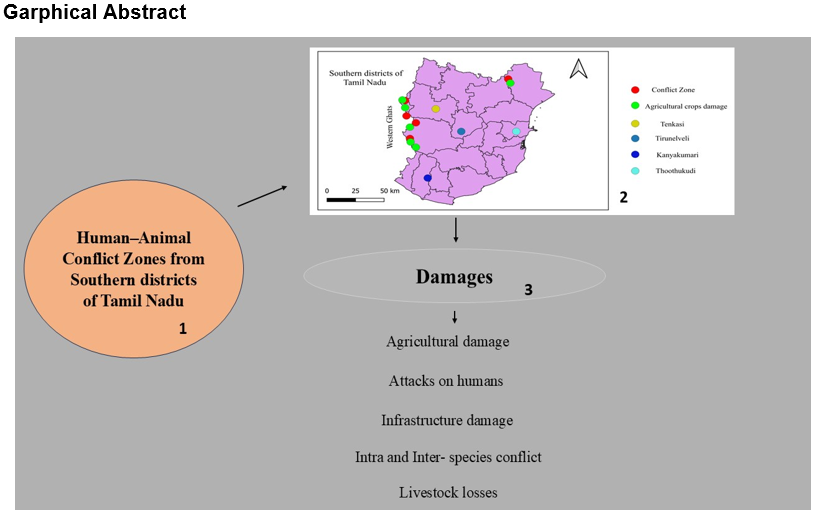
The study is aimed to explore the patterns, causes, and consequences of human-animal conflict (HAC) from the southern districts of Tamil Nadu, Tirunelveli (6,191 Sq. Km), Tenkasi (532.48 Sq. Km), Thoothukudi (4,707 Sq. Km), and Kanyakumari (1684 Sq. Km) between March 2024 and February 2025, totally 106 newspapers collected from Daily Thanthi and Thinakaran. During this period 94 conflict incidents were documented. The highest number of cases occurred in Tirunelveli (53.19%), followed by Tenkasi (38.3%), Thoothukudi (6.38%) and Kanyakumari (2.13%). Most conflicts occurred in agricultural areas (54.12%) and were concentrated during the night (45.88%) and daytime (43.53%). The primary causes of conflict included agricultural damage, livestock losses, infrastructure damage, and attacks on humans (injury/ kills), involving species such as elephants, wild pigs, bonnet macaques, langurs, and aggressive dogs. However, most conflict area was noted from Tirunelveli district, nearby Kalakad-Mundanthurai Tiger Reserve Forest boundary. This study emphasises the urgent need for mitigation measures, such as public awareness programs, better terrestrial-use planning, and coordinated efforts by forest authorities to balance conservation goals with human safety.
Keywords: Human-animal conflict, newspapers, KMTR, dog attacks